SWIR (Short-Wave Infrared) Camera White Paper
What short-wave infrared (SWIR) — invisible to the eye and to ordinary cameras — can show, how a SWIR sensor is built, and how it is used to inspect clear film packaging, explained with diagrams and test video.
1. Summary
Our eyes and ordinary cameras see visible light, about 400–700 nm. A SWIR (Short-Wave Infrared) camera sees longer light, about 1000–1700 nm. In this band, materials such as water and plastics absorb particular wavelengths, so things that look the same in visible light show up as differences in brightness. Clear plastic film is one of them.
| RGB camera | SWIR camera | |
|---|---|---|
| Light it sees | Visible, about 400–700 nm (sensor up to about 1000 nm) | About 1000–1700 nm (IMX990: 400–1700 nm) (spec) |
| Sensor material | Silicon | InGaAs (indium gallium arsenide) + silicon readout |
| Image | Colour | Mono (brightness) |
| Good at | Colour, text, shape | Differences in material — water, plastics, clear film — and what lies under visible inks |
| Resolution and price | High resolution, inexpensive | About 1.3 MP, expensive |
In one line: RGB sees *what colour and shape* something is; SWIR sees *what it is made of*. ROVI-SWIR uses this to decide whether clear film packaging is there or not.
2. Why an RGB camera cannot do it
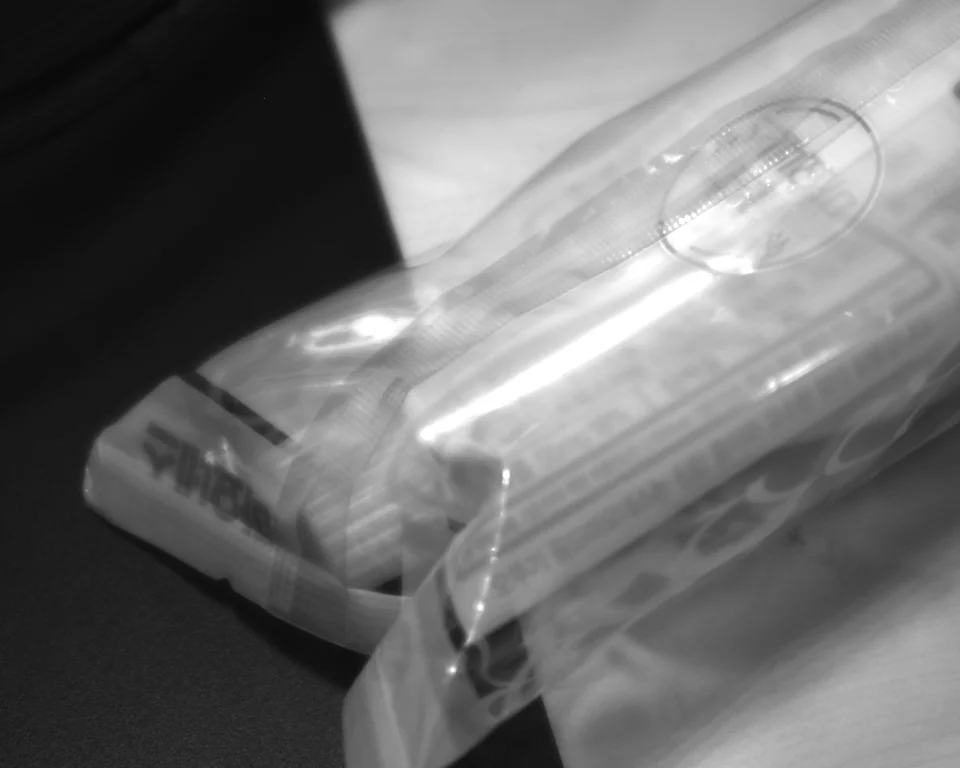
Clear film lets visible light through almost unchanged. In an ordinary camera, covered and bare areas look almost equally bright; what you see is the film's reflections (glare) and wrinkles. Reflections change with lighting angle and product position, so they make a poor basis for a decision.
In SWIR, the film itself absorbs and scatters certain wavelengths, so the covered area looks consistently darker. You are looking at a property of the material rather than at reflections, which makes the decision simple.
3. What SWIR is — wavelength bands
Light is named by its wavelength: about 400–700 nm is visible, 700–1000 nm is near infrared (NIR), and about 1000–1700 nm (up to 2500 nm in the wider sense) is short-wave infrared (SWIR).
- The limit of silicon: the silicon in ordinary cameras barely responds to light longer than about 1000 nm. Seeing SWIR needs a sensor made of a different material.
- Not a thermal camera: a thermal camera (LWIR, 8–14 µm) sees the heat an object gives off. SWIR, like visible light, sees light reflected from or passing through an object. So it needs illumination, passes through ordinary glass, and its images look like black-and-white photos.
4. Why materials look different
Bonds inside molecules (O-H, C-H and so on) absorb particular wavelengths, and these absorptions are concentrated in the SWIR band.
| Material | Absorbs at (approx.) | How it looks in SWIR |
|---|---|---|
| Water (O-H bonds) | about 970 · 1200 · 1450 · 1940 nm | Wet or moist areas look darker |
| Plastics and film (C-H bonds) | about 1210 · 1400 · 1730 nm | Even clear film looks darker in its absorption band |
| Many printing inks and dyes | Absorb visible light, absorb less in SWIR | What lies under the print shows through |
Where clear film covers the product, light crosses the film twice (going in and coming back out after reflecting), being absorbed and scattered each time, so the area looks darker.
5. SWIR sensor structure
The heart of a SWIR camera is an InGaAs (indium gallium arsenide) sensor. The Sony IMX990 (SenSWIR) used in ROVI-SWIR bonds a light-absorbing InGaAs layer onto a silicon readout circuit.
| Layer | What it does |
|---|---|
| InGaAs absorption layer | Absorbs light beyond 1000 nm and turns it into charge — the band silicon cannot see |
| Thinned InP layer | Thinning the light-entry layer lets one sensor see from visible (400 nm) to SWIR (1700 nm) (spec) |
| Copper-copper (Cu-Cu) bonding | Connects InGaAs and silicon directly at each pixel — keeps pixels small at 5 µm (spec) |
| Silicon readout circuit | Turns charge into a digital image, with a global shutter that captures all pixels at the same instant |
| Cooling (TEC) | InGaAs gets noisier (dark current) as it warms, so the sensor is cooled |
| Silicon CMOS (RGB camera) | InGaAs (SWIR camera) | |
|---|---|---|
| Sensitivity | about 400–1000 nm | 400–1700 nm (IMX990, spec) |
| Resolution | millions to tens of millions of pixels | 1280 × 1024 (1.3 MP) |
| Pixel size | 1–5 µm | 5 µm |
| Noise handling | usually no cooling | cooled to reduce dark current |
| Price | inexpensive | several times more |
6. Lighting and choosing the wavelength
Contrast in a SWIR image is set by which wavelength you shine on the scene. Broadband lighting (halogen and the like) mixes several absorptions and blurs the contrast, so you pick a narrow-band LED or filter at a wavelength the target material absorbs.
FLOYD photographed the same product with and without film under LED lighting at 8 wavelengths from 1050 to 1650 nm and compared which wavelength separated the two best.
- 1550 nm chosen: with film, the mean brightness dropped most clearly, from 249 to 237 (test). ROVI-SWIR uses 1550 nm lighting by default.
- 1650 nm: a similar drop in brightness, but the whole image was darker, so separation was lower than at 1550 nm.
- Exposure matters: once the image saturates, as at 1300 nm and below, no difference can be measured. Setting exposure for each wavelength is basic to SWIR inspection.
7. How ROVI-SWIR decides
Instead of an AI model, ROVI-SWIR decides with a single brightness value, using the physical fact that film-covered areas get darker at 1550 nm.
- Set an inspection area where the film should be.
- Take a few dozen pictures of products with and without film, and set a boundary (threshold) between their mean brightness.
- In operation, compare each image's inspection-area mean with the boundary to decide Wrapped / Non Wrapped, and send it with a score (0–1) to the screen, the app and a signal output.
| Feature | Details |
|---|---|
| No AI training | Start with a few dozen samples — no large labelled dataset, no GPU |
| Explainable | The decision rests on one thing, how dark the inspection area is — people can check results directly |
| Lightweight | Runs in real time on an edge device |
| Key to stability | Fixed lighting and exposure, and an inspection area that matches where the film is |
8. Test video
A test video of a cup product moved in front of the camera and decided in real time (1550 nm lighting). A blue box means Wrapped, an orange box Non Wrapped, and the score is at the bottom right.
9. Strengths and limits
Strengths
| Strength | Why |
|---|---|
| Sees differences in material | Water and plastics absorb in the SWIR band — same colour, different material, still distinguishable |
| Sees clear things | Clear film looks darker in its absorption band |
| Looks past print and dye | Many inks absorb less in SWIR, so what lies beneath shows |
| Handles haze | Longer wavelengths scatter less in haze and light fog than visible light |
| Simple decisions | With the right wavelength, brightness alone can decide |
Limits
| Limit | Details | What to do |
|---|---|---|
| Price and resolution | InGaAs sensors are expensive and about 1.3 MP | Choose lens magnification to give the needed resolution over the inspection area |
| No colour | Mono images — RGB suits colour and text inspection better | Pair with an RGB camera when needed |
| Depends on lighting | Sees reflected light, not heat — light wavelength and strength decide the result | Narrow-band LED lighting, block outside light |
| Exposure and saturation | With the wrong exposure the difference disappears (1300 nm and below in the test) | Per-wavelength exposure, fixed rather than automatic exposure |
| Sensitive to water | Moist targets look dark all over | Adjust wavelength and inspection area |
| Lenses | Ordinary lenses may lose focus and transmission in SWIR | SWIR-coated lenses |
10. Where to use it
Selection guide
◎ best · ○ possible · △ limited · ✕ unsuitable
| Task | SWIR | RGB | Thermal | Why |
|---|---|---|---|---|
| Clear film or wrap present | ◎ | △ | △ | Film looks darker in its absorption band (ROVI-SWIR) |
| Moisture and dryness | ◎ | ✕ | ○ | Water absorbs at 1450 nm |
| Telling plastics apart | ◎ | △ | ✕ | Each material absorbs at different wavelengths |
| Bruises and foreign matter in produce | ○ | ○ | △ | Differences in moisture and tissue |
| Checking under print and labels | ○ | ✕ | ✕ | Inks absorb less in SWIR |
| Colour, text, appearance inspection | △ | ◎ | ✕ | Colour is RGB territory |
| Temperature measurement | ✕ | ✕ | ◎ | Heat is thermal-camera territory |
FLOYD's application
ROVI-SWIR is being commercialised first for deciding whether film-wrapped products such as cup noodles are wrapped (UX packaging, 2026), supplied through SI partners or directly to end customers.
11. Camera and ROVI-SWIR
LUCID Atlas SWIR 1.3MP
| Item | Details (spec) |
|---|---|
| Model | Atlas SWIR 1.3MP (ATP013S) |
| Sensor | Sony IMX990 InGaAs (SenSWIR) · 1/2" |
| Resolution and pixel | 1280 × 1024 · 5 µm |
| Sensitivity | 400–1700 nm (mono) |
| Shutter and speed | Global shutter · up to 84.9 fps |
| Cooling | TEC (sensor cooling) |
| Interface and protection | GigE Vision · PoE+ · IP67 |
| Lens | C-mount |
ROVI-SWIR
| Item | Details |
|---|---|
| Camera | LUCID SWIR camera (short-wave infrared) |
| Lighting | 1550 nm narrow-band LED |
| Processing | Edge device · no AI training |
| UX | Headless device + companion app |
| OS | Windows / Ubuntu 22.04 |
| Maturity | Commercialising — UX packaging and commercialisation (2026) |
Send application review requests through floyd.kr contact.
12. Glossary
| Term | Meaning |
|---|---|
| SWIR | Short-Wave Infrared. Light of about 1000–1700 nm (up to 2500 nm in the wider sense) |
| NIR | Near Infrared. About 700–1000 nm |
| LWIR, thermal | Long-Wave Infrared (8–14 µm). Sees the heat an object gives off |
| InGaAs | Indium gallium arsenide. A semiconductor sensitive into SWIR — the material of SWIR sensors |
| Absorption band | A wavelength a material absorbs strongly — around 1450 nm for water, 1730 nm for plastics, and so on |
| Narrow-band lighting | LED or filtered lighting that gives light around one wavelength only |
| Saturation | The image stuck at maximum brightness (255), so no difference can be seen |
| Inspection area (ROI) | The part of the image used for the decision |
| Threshold | The brightness boundary between film and no film |
| Separation d′ | How far apart the two brightness distributions are; higher means easier to tell apart |
| Global shutter | Captures all pixels at the same instant — moving products are not distorted |
| TEC | Thermoelectric cooler. Cools the sensor to reduce noise |